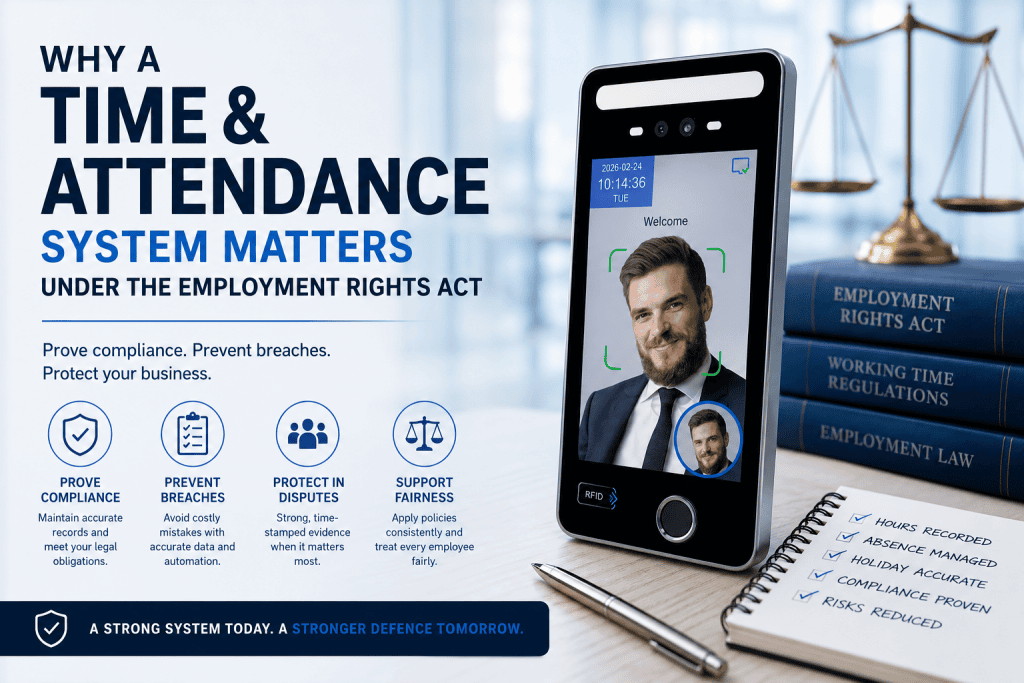
A reliable time and attendance system does more than record when employees clock in and out.
When it comes to the UK Employment Rights Act (ERA), accurate records of worked hours, absence, and absence entitlement can play an important role in helping organisations:
- Prove compliance
- Prevent accidental breaches
- Protect themselves in employment disputes
Here’s how effective time and attendance management can support employers across key areas of the ERA.
1. Protection against unlawful deductions of wages
Employers must not make unauthorised deductions from employees’ wages. Without accurate records, organisations can face:
- Disputes over hours worked
- Manual recording errors
- Unclear absence records
- Questions around whether pay has been correctly calculated
With QuickClocks , employers can maintain an objective record of working hours and attendance, creating a clear audit trail between attendance and payroll.
Employer benefit: When pay is challenged, you have accurate records to support your position.
2. Accurate holiday entitlement and holiday pay
Holiday entitlement and holiday pay can become complicated, particularly for part-time, irregular-hours, or shift-based employees.
Without an effective system, businesses may face:
- Incorrect holiday accrual
- Over- or under-payment
- Errors in leave balances
- Difficulties tracking entitlement
QuickClocks helps organisations maintain clear records of leave taken, remaining entitlement, and absence data.
Employer benefit:
Better records can help reduce the risk of costly holiday-related disputes.
3. Supporting unfair dismissal and redundancy decisions
Employment decisions need to be supported by fair and consistent evidence.
Relying on spreadsheets, memory, or inconsistent absence records can make it difficult to demonstrate that decisions were based on objective information.
With QuickClocks, organisations can maintain:
- • Time-stamped attendance records
- • Consistent absence history
- • Clear records of attendance patterns
- • Objective data to support management decisions
Employer benefit:
Attendance-related decisions become evidence-based rather than dependent on memory or opinion.
4. Managing sickness and statutory leave
Accurately categorising absence is essential.
Incorrectly recording sickness or statutory leave as unauthorised absence can create unnecessary risk and may lead to employees being treated inconsistently.
QuickClocks can help organisations maintain clear categories for different types of absence and track relevant entitlement.
Employer benefit:
Better visibility helps reduce the risk of administrative errors and inconsistent treatment.
The short version for business leaders
A reliable time and attendance system like QuickClocks can help organisations:
- Maintain accurate working-hour records
- Reduce payroll and holiday-related disputes
- Strengthen attendance and absence records
- Support fair and consistent workforce decisions
- Improve visibility across the workforce
- Create a clear audit trail for employment records
In simple terms, it can help turn:
“We believe we acted fairly.”
into:
“Here are the records that show what happened.”